A parcel sent across town is handled a handful of times. The same parcel sent to a customer in another country is handled dozens of times, transferred between road, air and sea transportation, stacked under unfamiliar loads, and held in customs where nobody has any reason to be gentle with it.
International shipping packaging exists to survive that journey. The packaging that works fine domestically frequently does not, and the gap between the two is where damage, penalties and returned goods come from.
This guide covers how to pack products for export, how to choose the right packaging materials, the labels and regulations you need to know, and how to keep shipping costs under control while doing it.
Why International Shipping Packaging Is Different
Three factors change once a shipment crosses a border.
The journey is longer and more complex. A domestic parcel moves through one carrier network. An international shipment may be packed onto a pallet, moved by road to a port, loaded into a container, carried by sea or by flight, unloaded, broken down, and delivered by a local parcel carrier at the destination. Every transfer point is a chance for shock, compression and drop damage.
Conditions vary more. Temperature and moisture swing far more across a sea journey or a long flight than they do on a domestic road route. Corrugated loses strength as it absorbs humidity, which matters when boxes are stacked for days.
Compliance is enforced. Governments inspect goods crossing their borders. Packaging that is not compliant can be delayed, refused, treated or destroyed, and the consequences land on you rather than on the carrier.
Understanding those three factors is what separates packaging that simply contains a product from packaging designed for the route it will actually take.
What Your Shipment Actually Experiences
Before you choose materials, it helps to picture the journey.
A typical export shipment is packed at origin, palletised, stacked with other freight, moved by road, transferred to air or sea transportation, stored, cleared through customs, moved again, then broken down into individual parcels for final delivery. Time in transit ranges from a few days by air to several weeks by sea.
The practical consequence is that your packaging has to handle stacking strength and durability over time, not just a single drop. A box that survives being dropped once may still fail after two weeks under load in a humid container. If you want to know whether a design will hold, package testing standards provide a repeatable way to find out before you ship rather than after.
Choosing the Right Packaging Materials

The right packaging materials for international shipping are chosen for the route, not for convenience.
Corrugated Boxes
The outer box carries the load. For export, that usually means a heavier grade than you would use domestically. Double wall corrugated boxes are the common choice for goods that will be stacked or containerised, because single wall loses strength quickly under sustained compression and moisture.
Size matters as much as strength. A box that is too large invites the contents to move and adds volumetric weight; a box that is too small leaves no room for cushioning. Choose the size that lets you protect the product with the minimum surrounding space.
Cushioning and Void Fill
Inside the box, cushioning absorbs shock and void fill stops the product moving. These are different jobs and both matter on a long journey.
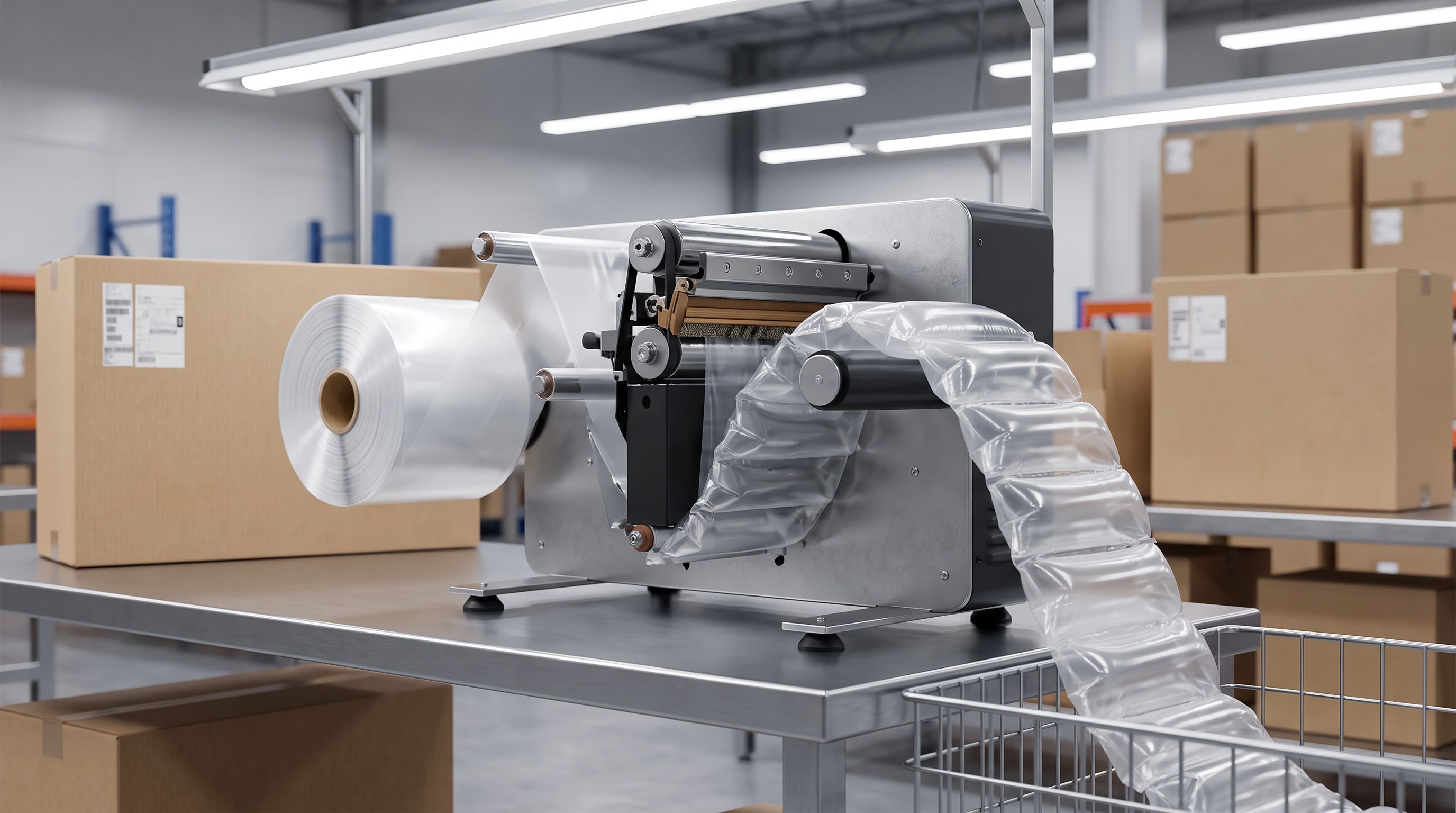
Traditional options include bubble wrap, foam and packing peanuts. Each has trade-offs in cost, storage space and waste. Air pillow packaging is widely used for international shipments because the material ships and stores flat and is inflated on demand at the packing bench, which removes the warehouse space that pre-filled cushioning consumes.
One point specific to air transportation: air cushions are inflated at ground level and travel in a pressurised hold, so the pressure differential they experience is modest. Quality film handles this without issue, but it is a fair question to ask a supplier, and a reason to pay attention to film quality rather than buying on price alone.
For a fuller comparison of the options, see our guide to void fill packaging types and best practices.
Secondary Packaging and Pallets
For larger shipments, secondary packaging holds individual boxes together as a single unit. Stretch wrap, strapping and edge protectors keep a pallet stable through handling.
If you use wood pallets or wood crates, read the regulations section below before you ship. Wood packaging is one of the most common causes of an export shipment being held.
Labels, Documentation and Compliance

Labels do more work on an international shipment than a domestic one.
The shipping label must be securely attached, flat, and on the largest face where it can be scanned. A label that peels off in a humid container leaves an anonymous box.
Customs documentation typically travels in a document pouch on the outside of the parcel. The commercial invoice, packing list and any certificates of origin need to be complete and to match what is actually inside. A mismatch between the declared contents and the physical shipment is a reliable way to have goods held.
Handling marks such as fragile, this way up, or keep dry communicate orientation and care to people who may not share your language. Pictorial marks work better than words for this reason.
Address information should appear both outside and inside the box. If the outer label is destroyed, an internal copy is the only thing that lets a carrier reunite the parcel with its destination.
Regulations You Need to Know
Compliance is where international shipping packaging differs most from domestic practice. Three areas catch businesses out repeatedly.
Wood packaging. Solid wood pallets, crates and dunnage must generally be heat treated or fumigated and stamped under the ISPM 15 standard, which exists to stop insects moving between countries. Untreated wood is refused at many borders. Plastic and corrugated alternatives avoid the requirement entirely.
Lithium batteries. Products containing lithium batteries, including most electronics, are regulated as dangerous goods in air transportation. Requirements cover state of charge, packaging, marks and documentation, and they are enforced. Confirm the current rules for your product and route before you ship.
Destination market rules. The European Union and other markets set requirements on packaging waste, recyclability and producer responsibility. These affect what you send and what you may need to register or report. Requirements change, so review them for each market you sell into rather than assuming what applied last year still applies.
Packaging that is not compliant does not simply arrive late. It can be treated, repacked or destroyed at your expense, and repeated failures affect how your shipments are handled in future.
Controlling International Shipping Costs
International shipping costs are driven by weight and by volume, and for most parcels it is volume that decides the price.
Carriers bill on dimensional weight when a package is light for its size. A right-sized box with the product protected in less surrounding space costs less to send than a larger box padded out with filler, and the difference compounds across every shipment. Our guide to reducing dimensional weight charges covers the calculation and how to act on it.
A few other cost factors are worth understanding:
- Stackability. Pallets that stack cleanly use container space efficiently. Irregular loads waste paid volume.
- Material weight. Heavy cushioning adds billable weight on every parcel. Air based cushioning is close to weightless by comparison.
- Damage rate. A damaged shipment costs the product, the freight, the replacement and the customer relationship. Preventing damage is almost always cheaper than processing shipping damage claims.
- Storage and handling. Cushioning that arrives flat and inflates on demand frees warehouse space and reduces the labour of handling bulky material.
Practical Tips for Packing International Shipments
A short checklist that covers most of what goes wrong:
- Choose the box for the journey, not the product. Longer routes and sea freight need more strength.
- Protect the corners and edges. Most impact damage arrives there first.
- Leave no free space. Contents that move will break. Void fill is not optional on a long journey.
- Seal properly. Tape all seams; a single strip across the middle is not enough for export.
- Put the address inside as well as outside.
- Photograph the packed shipment. It costs a minute and it is the evidence that matters in a claim.
- Ship a test unit first. Sending one piece to a new destination before committing a container is cheap insurance.
Packing Materials and Shipping Supplies Checklist
Most businesses can cover the majority of their export shipments with a short, well chosen list of packing materials rather than a warehouse full of different types of supplies.
Outer boxes. Double wall corrugated boxes in three or four sizes that match your products. Keeping the range small makes it easy for the team to pick the right box quickly, and it improves how well pallets stack.
Cushioning. One system that protects the products you actually ship. Mixing several types of packing materials usually means none of them is stocked properly.
Void fill. Something to occupy the space around the product so the contents cannot move.
Tape. A quality water activated or reinforced tape. Standard office tape is not suitable for export.
Edge and corner protection. Cheap, light, and it protects the part of the box that is hit first.
Labels and document pouches. Enough to ensure every shipment leaves with its paperwork securely attached.
Stretch wrap and strapping for palletised goods.
Buying shipping supplies against this list rather than reacting to each order makes packaging and shipping predictable, and it is far easier to control a budget you can evaluate against known volumes.
Getting Your Team and Your Customers Aligned
Packaging is the last step your business controls and the first thing the customer sees, so it is worth treating as more than a technical problem.
Train the team on the standard. If three people pack the same product three different ways, you will get three different damage rates. A simple one page guide at the bench, showing the correct box, the correct materials and the correct seal, removes most of that variation.
Use packaging as branding where it makes sense. A clean, well packed parcel arriving intact communicates professionalism and builds confidence in your business. That matters in new markets where customers have no other experience of you. Branding should never come at the cost of protection, but the two are rarely in conflict.
Tell customers what to expect. Sharing realistic delivery information and lead times reduces the support load and protects the relationship when a shipment is slow through customs. Clients who know a shipment takes three weeks by sea do not raise a case on day four.
Review what comes back. Damaged goods carry information. If the same product arrives broken in the same way, the packaging design is telling you something specific, and it is usually cheaper to fix than to keep absorbing.
A Pre-Shipment Checklist You Can Follow
A short list to run through before an international shipment leaves. Most of what goes wrong is on it.
Confirm the box type suits the route. Double wall for sea freight and long transit; single wall is rarely enough for export. Choose the box type for the journey, not for what is on the shelf.
Check the products are protected individually. Items that touch each other inside a carton abrade in transit. Protect each piece, then fill the void around them.
Pack to eliminate movement. Shake the sealed box. If anything shifts, it is not packed. This single test catches most damage before it happens.
Verify the materials are right for the destination. Wood packaging needs treatment and marking. Some goods and some markets have their own packaging requirements. Understand them before you pack rather than after a shipment is held.
Confirm labels are complete and securely attached. Shipping label flat on the largest face, documentation in a pouch, handling marks visible, and a duplicate address inside the box.
Photograph the packed shipment. It takes a minute and it is the only evidence that matters if you need to claim.
Keep a written packing standard. When several people pack international shipments, a one page guide showing box type, materials and seal for each product line is what keeps quality consistent. It is also the fastest way to bring a new team member up to speed.
Following the same essential practices on every shipment is what makes international packing predictable. Operations that pack to a standard see fewer surprises than operations that pack to whatever is nearest the bench.
Understanding Your Supply Chain End to End
The packaging decision is easier when you understand the full path your goods take.
Ask your freight forwarder what actually happens to a shipment on each lane you use. How many times is it handled? Does it transfer between modes of transport? How long does it sit, and where? A pallet that spends three weeks in a humid port needs different packaging and shipping decisions from one that flies out on Tuesday.
That information is usually available for the asking, and most businesses never ask. Knowing it lets you choose materials for the real journey rather than an imagined one, and it tells you which lanes are worth protecting more heavily. It also helps when you are sending products to a new market for the first time and have no damage history to learn from.
Frequently Asked Questions
What is the best packaging for international shipping?
There is no single best option. For most products, a double wall corrugated box sized closely to the contents, with cushioning that immobilises the product and fills the void, covers the majority of routes. Heavy or high value goods may need crating.
Do I need different packaging for sea freight than for air?
Generally yes. Sea transit is longer and more humid, so board strength and moisture resistance matter more. Air shipments move faster but face stricter regulations on dangerous goods such as lithium batteries.
How do I stop customs holding my shipment?
Make the documentation match the goods exactly, attach it securely to the outside, and make sure any wood packaging is treated and marked. Most holds trace back to paperwork or to wood.
Can I reuse boxes for export shipments?
It is rarely a good idea. A used box has already absorbed compression and moisture and has lost a meaningful share of its original strength, which is exactly what a long international journey tests.
How do I reduce international shipping costs without risking damage?
Reduce the volume rather than the protection. Right size the box, then use cushioning that protects in less space. Cutting protection to save freight usually costs more in damage than it saves in postage.
Talk to a Packaging Specialist
International shipping punishes packaging that was designed for a shorter journey. If you are expanding into new markets, or seeing damage on routes that used to be fine, the packaging is usually the place to look first.
AIRFILL Technologies works with businesses shipping goods worldwide to design protective packaging around the route the product actually takes.
Request a free consultation and talk to a packaging specialist about your shipments.