E-commerce shipping has changed more in the last five years than in the previous twenty. Order volumes have grown, carrier rates have climbed, customer expectations for fast and damage-free delivery have hardened into the baseline, and sustainability has shifted from a marketing add-on to a procurement requirement. Sitting in the middle of all of this is one of the most overlooked levers in the operation: the packaging that fills the empty space inside the box.
Inflatable packaging has become the default protective solution for serious e-commerce operations because it solves more problems at once than any traditional alternative. It protects products in transit, keeps DIM weight charges low, accelerates the packing line, takes up almost no warehouse space until it’s needed, and meets sustainability targets when specified correctly.
This guide covers everything an operations leader, procurement manager, or fulfillment director needs to know about inflatable packaging for e-commerce. What it is, how it compares to alternatives, how to choose the right type, what implementation actually looks like, and how to evaluate the total cost impact for your specific shipping profile.
What Is Inflatable Packaging?
Inflatable packaging is a category of protective packaging that uses air as the primary cushioning material. Instead of relying on the volume of a foam, paper, or plastic substance, inflatable packaging uses thin plastic film that is inflated at the moment of use to create air-filled cushions, pillows, columns, or wraps.
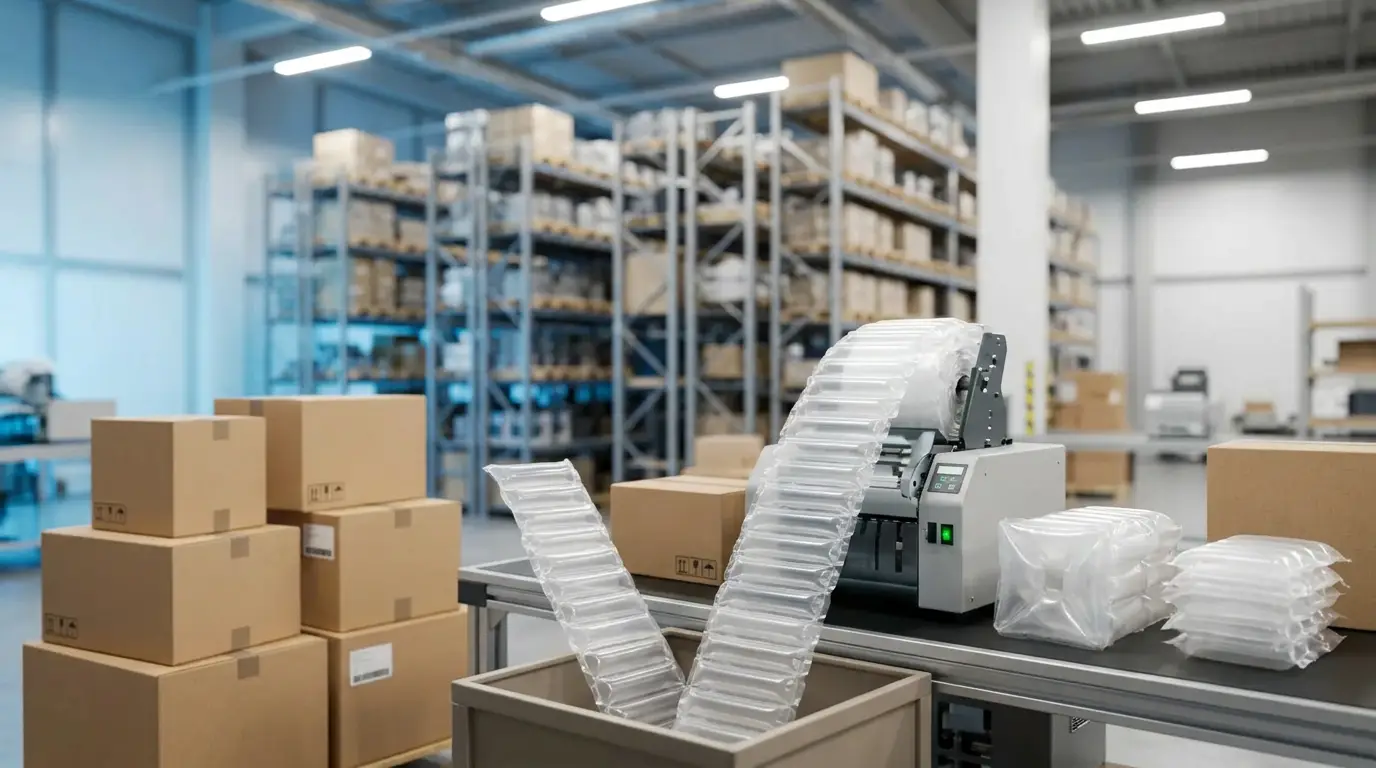
The mechanics are simple. A roll of pre-formed plastic film, perforated into individual cells, feeds through an inflation machine. The machine pushes air into each cell and seals it as it exits. The packer drops the inflated material into the carton around the product, the box gets taped, and the shipment goes out.
Three things make this category fundamentally different from traditional protective packaging:
-
The cushioning is created on demand. A roll of unfilled film smaller than a microwave can produce thousands of air pillows. The air doesn’t exist as inventory until the packer needs it.
-
The film-to-cushion ratio is extreme. A pound of plastic film inflated into pillows produces dozens of times the protective volume of a pound of bubble wrap or packing peanuts.
-
The packaging is lightweight by design. Air weighs almost nothing, which means inflatable packaging adds minimal mass to the shipment and minimal cubic volume relative to the protection delivered.
These three properties drive every cost, performance, and sustainability advantage discussed in the rest of this guide.
The Main Types of Inflatable Packaging
Not all inflatable packaging is the same. The category includes several distinct product types, each engineered for different applications.
Air Pillows
Air pillows are the most common form of inflatable packaging in e-commerce. They are small to medium rectangular cushions, typically 4×8 inches up to 8×12 inches, used as void fill around the product inside the carton. They prevent the product from shifting, fill empty space efficiently, and absorb shock during handling.
Air pillows are the right choice for most general e-commerce applications: fulfilling orders of mixed product sizes, filling void space around items already in retail packaging, and protecting non-fragile or moderately fragile products.
Air Cushion Packaging
Air cushion packaging refers to larger or interconnected inflatable units used for direct product wrapping rather than just void fill. These can include quilted air sheets, larger pillow assemblies, or pre-formed shapes designed to wrap around specific product types. Air cushion systems are the right choice when products need direct cushioning on multiple surfaces, not just immobilization in the carton.
Air Column Bags
Air column bags are inflatable bags made of multiple parallel columns. When inflated, they form a rigid yet flexible protective barrier that wraps around the product. The redundancy of multiple columns means a puncture in one column doesn’t compromise overall protection. Air column bags are the right choice for high-value or highly fragile products where damage is unacceptable: electronics, glass bottles, sensitive instruments.
Inflatable Bubble Wrap
Inflatable bubble wrap is sold as deflated rolls and inflated on demand using the same machinery as air pillows. Functionally similar to traditional bubble wrap, but it ships and stores at a fraction of the volume. It’s the right choice when you need surface wrapping for individual items but want to avoid storing pre-inflated bubble wrap rolls.
Most e-commerce operations use a combination, typically air pillows for void fill and air column bags or inflatable bubble wrap for higher-value items. The same inflation machine usually handles multiple film types, so adding a second product format is a film order, not a new equipment investment.
Why E-Commerce Specifically Benefits From Inflatable Packaging
Every business that ships products benefits from better packaging, but e-commerce operations benefit disproportionately from inflatable packaging for four reasons.
The volume math is unforgiving. E-commerce ships individual orders, not pallets. Every order is its own packing event with its own labor cost, materials cost, and damage risk. A 5 percent improvement in packing speed or a 1 percent reduction in damage rate compounds across every shipment, every day. This is exactly the scale where inflatable packaging’s per-package efficiency matters most.
Carrier rates punish volume. UPS, FedEx, USPS, and DHL all bill commercial e-commerce shippers using DIM weight pricing for any package above minimum thresholds. A box that’s “right-sized” with thin air pillows costs measurably less to ship than the same product protected with thicker materials. Over a year of shipments, this difference often outweighs the entire packaging material spend.
Returns are expensive and getting more so. E-commerce returns are running at 15 to 25 percent of orders for many categories, and the carrier and labor cost of every return is borne by the seller. Damaged-on-arrival shipments are the most expensive returns of all because they include replacement product cost, return shipping, and customer churn risk. Better protective packaging reduces this category of return more than any other operational change.
Customer experience starts at the unboxing. E-commerce buyers form an opinion of your brand within seconds of opening the box. Loose packing peanuts spilling onto the floor, crushed paper that looks like trash, or a damaged product all communicate the same message. Air pillows are clean, contained, and easy to dispose of, which is a small but real factor in customer satisfaction and repeat purchase rates.
These four factors compound. Operations that switch to inflatable packaging at scale frequently see double-digit improvements across multiple metrics simultaneously, not just the line item the procurement team was originally targeting.
Inflatable Packaging vs Traditional Alternatives
The honest comparison between inflatable packaging and traditional protective materials looks different depending on which costs you measure. Material price alone tells one story. Total cost of ownership tells another.
Inflatable Packaging vs Packing Peanuts
Packing peanuts (whether traditional polystyrene or starch-based biodegradable) are inexpensive per cubic foot but expensive in every other dimension. They require massive storage space, scoop slowly into boxes, settle and shift during transit, leave a mess at the unboxing, and add significant weight in the biodegradable starch versions. Inflatable packaging fills the same void space with a fraction of the labor time, no storage liability, no settling problem, and no mess.
For high-volume e-commerce operations, the labor and storage savings alone typically justify the switch within 60 to 90 days.
Inflatable Packaging vs Bubble Wrap
Pre-inflated bubble wrap performs well as direct product wrap, but it’s a storage and shipping nightmare. Bubble wrap is essentially packaged air being trucked across the country and stored in your warehouse. Inflatable bubble wrap, inflated on demand from compact film rolls, delivers the same protection with a fraction of the storage and freight cost.
For protection comparisons specifically, conformable air pillows often outperform bubble wrap for void fill applications because they fill irregular spaces more effectively.
Inflatable Packaging vs Crumpled Paper
Crumpled kraft paper has gained popularity as a “sustainable” alternative, but it has real performance limitations. It compresses under load, doesn’t immobilize products as effectively as air-filled materials, generates dust in the warehouse, and requires significant labor to crumple and place properly. Inflatable packaging delivers better protection per cubic inch, faster packing speed, and (with curbside-recyclable film) a comparable sustainability profile.
Inflatable Packaging vs Foam Inserts
Custom foam inserts are the gold standard for protection of very high-value or oddly-shaped products, but they are SKU-specific, expensive to produce, slow to source, and difficult to dispose of sustainably. Inflatable packaging is faster to deploy, works across multiple SKUs, and meets most protection requirements at a fraction of the cost. Foam inserts still have a place for products with unusual protection requirements, but they are rarely the right answer for general e-commerce fulfillment.
How On-Demand Inflation Systems Work
The mechanical reality of an on-demand inflation system is simpler than most operations leaders expect.
A small countertop or wall-mounted machine sits at or near the packing station. A roll of pre-formed plastic film loads into the back of the machine, similar to loading paper into a printer. The machine plugs into a standard power outlet. When the operator presses a foot pedal or button, the machine feeds the film through, inflates each cell with ambient air, and seals it. The inflated chain of pillows comes out the front, and the packer tears off the amount needed for the current package.
The machines themselves are compact, typically the size of a small microwave or under-counter unit. They produce 30 to 70 feet of inflated film per minute, which is more than fast enough for most packing line speeds. Maintenance is minimal: occasional cleaning, the rare film roll change, and standard preventive checks.
The operational model that has taken over the industry is the no-cost machine lease, where the equipment is provided alongside the film supply contract. The operation pays for the consumable film, and the inflation machine itself is included. This eliminates the capital expense barrier that historically slowed adoption and keeps the cost structure aligned with shipping volume.
For most e-commerce operations, integrating an on-demand inflation system requires no changes to the existing packing workflow beyond replacing the void fill step. Packers still pick, pack, and tape. The machine slots into the workflow at the void fill stage, where it produces inflated pillows on demand instead of the packer reaching for peanuts or bubble wrap.
The Total Cost of Inflatable Packaging
Material price is the most visible cost of any packaging system, and it’s also the least useful number for evaluating total cost of ownership. The full cost stack of any protective packaging includes five things: material cost, labor cost, storage cost, DIM weight surcharges, and damage claim cost.
Inflatable packaging changes the math on four of those five. Material cost per shipment for inflatable packaging is typically comparable to or slightly above bubble wrap and below air-cushion packing foam. The savings come from everything else.
Labor cost drops because on-demand inflation reduces void fill time from 30 to 60 seconds per package down to 5 to 10 seconds per package.
Storage cost drops because uninflated film rolls take up roughly 1/50th the warehouse space of pre-inflated bubble wrap or bagged peanuts.
DIM weight surcharges drop because air-filled pillows add far less cubic volume to the shipment than equivalent traditional materials.
Damage claim cost drops because conformable air-filled cushioning immobilizes products more effectively than loose fill, reducing the breakage rate on fragile and irregularly-shaped items.
When operations actually model the full cost stack, on-demand inflatable packaging typically reduces total packaging cost by 20 to 40 percent versus the traditional alternative being replaced. The size of the reduction depends heavily on shipping volume and current damage rates: high-volume operations and operations with elevated damage rates see the largest improvements.
Choosing the Right Inflatable Packaging for Your Products
The right packaging specification depends on three product variables: weight, fragility, and shape consistency.
Lightweight, non-fragile products with consistent shapes (apparel, soft goods, books, packaged consumer goods) need air pillows for void fill only. The product itself doesn’t need direct cushioning. The job of the packaging is to immobilize the product in the carton and prevent it from shifting during transit.
Moderately fragile products with consistent shapes (electronics in retail boxes, packaged housewares, beauty products in primary packaging) need air pillows for void fill plus inflatable bubble wrap or air cushion packaging around the primary product packaging. The double layer absorbs both shock and vibration.
Highly fragile or high-value products (glass bottles, sensitive electronics, scientific instruments, ceramics) need air column bags or specialty air cushion packaging that wraps the product directly. The redundant column structure and direct surface contact deliver protection that approaches custom foam inserts at a fraction of the cost.
Heavy or irregularly-shaped products (automotive parts, large electronics, furniture components) often benefit from larger air cushion sheets or quilted air packaging that can wrap and immobilize across longer dimensions.
The size of the air pillow matters as well. Pillows that are too small leave void space that the product can shift through. Pillows that are too large get crushed and lose protective effectiveness. Most operations use two or three pillow sizes across their product mix, sized to the carton dimensions used for the highest-volume SKUs.
For mixed e-commerce operations shipping a wide product range, the most common starting configuration is medium air pillows for general void fill plus a roll of air column bag film for high-value SKUs, both run through the same inflation machine.
Sustainability and Recyclability
Sustainability is no longer optional for serious e-commerce operations. Corporate ESG commitments, retailer mandates, and increasingly state-level packaging regulations have made sustainable packaging a procurement requirement, not a marketing nice-to-have.
Inflatable packaging has a strong sustainability profile when specified correctly, and a weak one when it isn’t. The variable is the film material itself.
Curbside-recyclable air pillow film is widely available and meets the requirements of most municipal recycling programs and corporate ESG commitments. These films are typically polyethylene-based and accepted in the same waste stream as plastic shopping bags and plastic film at most curbside recycling pickup or store drop-off programs.
Standard polyethylene film without the curbside-recyclable specification is recyclable through store drop-off programs but not through municipal curbside pickup, which can be a meaningful difference for end-customer experience and corporate reporting.
Bio-based or compostable film is available for operations with stricter environmental requirements but typically carries a price premium and requires industrial composting infrastructure to actually compost.
The sustainability advantage of inflatable packaging over traditional alternatives is real but specification-dependent. A box of curbside-recyclable air pillows has a meaningfully smaller environmental footprint than the equivalent volume of bubble wrap, packing peanuts, or foam (per pound of plastic shipped, per cubic foot of warehouse space, per truck mile to deliver). A box of standard non-recyclable air pillow film does not necessarily improve on bubble wrap.
When sustainability matters to the buying decision, the right question to ask the supplier is specifically: “Is the film curbside-recyclable in the markets we ship to, and can you provide third-party documentation?”
Implementation Considerations
Switching to an inflatable packaging system is operationally simpler than most teams expect, but it benefits from a deliberate rollout.
Timeline. A typical changeover from contract signature to live operation takes 1 to 2 weeks. This includes machine delivery, packer training, film roll inventory setup, and a brief overlap period where both old and new systems run in parallel.
Training. Inflation machines are designed to be operator-friendly. Most packers reach proficiency within 30 minutes of hands-on training. The machine handles the inflation; the packer just decides how much inflated film to drop into each carton.
Workflow integration. The inflation machine slots into the existing packing workflow at the void fill step. No changes are required to the upstream pick process or the downstream tape, label, and ship steps.
Capital requirements. Under a no-cost machine lease, capital requirements are zero. The inflation machine is provided as part of the supply relationship, and the operation pays only for the consumable film.
Backup planning. Most operations using on-demand inflation keep a small backup supply of pre-inflated material on hand for the rare event of a machine maintenance issue. This is typically a single bag of pillows, not a meaningful inventory commitment.
Multi-station setups. High-volume operations with multiple packing stations typically deploy one inflation machine per station rather than centralizing inflation. This keeps the inflated material flow tight to the workstation that needs it.
Industries That Benefit Most
Inflatable packaging is the right choice for almost every category of e-commerce shipper, but some industries see disproportionate benefit.
Electronics and consumer technology operations gain from the combination of fragility protection and BPA-free, RoHS-compliant material specifications.
Wine, beer, and spirits shippers gain from the combination of damage protection (air column bags around bottles) and the ability to ship in lightweight cartons that don’t trigger DIM weight surcharges.
Pharmaceuticals and medical equipment operations benefit from the cleanroom-compatible nature of inflated air pillows compared to dust-generating alternatives like crumpled paper.
Furniture and large items benefit from the larger air cushion formats that can wrap and immobilize across multiple dimensions.
Beauty, cosmetics, and personal care operations benefit from the unboxing experience improvement and the recyclable specifications that align with the sustainability messaging these brands typically lead with.
3PL fulfillment centers operating across multiple client accounts benefit from the flexibility of a single inflation system handling air pillows, air cushions, and inflatable bubble wrap from the same machine, depending on what each client’s products require.
Frequently Asked Questions
What’s the difference between air pillow packaging and air cushion packaging?
Air pillow packaging refers specifically to small to medium inflated rectangular cushions used primarily as void fill around products inside a carton. Air cushion packaging is a broader category that includes air pillows along with larger inflated structures used for direct product wrapping, including air column bags and quilted air sheets. Most e-commerce operations use both: air pillows for general void fill and air cushion or column bag formats for higher-value or fragile items.
Is inflatable packaging cheaper than bubble wrap?
Material cost per shipment is comparable, but total cost of ownership is meaningfully lower for inflatable packaging once labor, storage, DIM weight, and damage costs are included. Most operations that switch from bubble wrap to on-demand inflatable packaging see 20 to 40 percent reduction in total packaging cost.
Do I need to buy an inflation machine?
Not under a no-cost machine lease arrangement. The machine is provided alongside the supply contract, and the operation pays only for the consumable film. This eliminates the capital expense that historically slowed adoption.
How fast can an inflation machine produce air pillows?
Most commercial inflation machines produce 30 to 70 feet of inflated film per minute, which is more than fast enough to keep up with typical e-commerce packing line speeds. High-volume operations sometimes deploy multiple machines across multiple packing stations to keep the material flow tight to each workstation.
Is inflatable packaging recyclable?
It depends on the film specification. Curbside-recyclable polyethylene films are widely available and accepted in most municipal recycling programs. Standard polyethylene films are recyclable through store drop-off programs but not always curbside. When sustainability matters, ask the supplier specifically for curbside-recyclable film with documentation.
What products should not use inflatable packaging?
Very few. The main exceptions are products that need extreme dimensional precision protection (some scientific instruments, certain medical devices) where custom foam inserts remain the standard, and products that need ESD (electrostatic discharge) protection at a level that requires specialty antistatic foam. For the vast majority of e-commerce shipments, inflatable packaging is the right answer.
How long does inflated air pillow packaging hold its air?
Properly sealed inflatable packaging holds air for the duration of any standard transit cycle, including extended international shipments. Quality films with proper seals retain inflation for weeks to months under normal conditions.
Does inflatable packaging work for international shipping?
Yes. The lightweight nature of inflatable packaging is actually an advantage for international shipments where every pound of weight and every cubic inch of volume affects freight cost meaningfully. The packaging holds its protection through the longer transit times and additional handling that international shipments involve.
Getting Started With Inflatable Packaging
For e-commerce operations evaluating inflatable packaging, the practical next step is a packaging cost analysis that measures the current state across the full cost stack: material, labor, storage, DIM weight, and damage claims. Without those numbers, comparing material price alone misses the majority of the cost impact.
AIRFILL Technologies provides this analysis as part of the no-cost machine lease evaluation. The process maps the operation’s current packaging cost against an on-demand air-filled alternative, models the projected savings, and identifies the right film specifications for the product mix. There is no purchase commitment required to run the analysis.
Inflatable packaging is the default protective solution for serious e-commerce operations because it solves more problems at once than any traditional alternative. The case for switching is rarely based on a single metric. It’s based on the compounding benefit across material efficiency, packing speed, storage footprint, shipping cost, damage prevention, and sustainability compliance.
For most e-commerce operations, the question is no longer whether inflatable packaging is the right answer. It’s how quickly the changeover can happen and how soon the operation starts capturing the savings.
Request a packaging cost analysis to see what the numbers look like for your specific shipping profile.