If you ship physical products, your packaging line is quietly leaking money. Most procurement and operations leaders focus on the obvious line item, the cost of materials per shipment, and miss the four other cost drivers stacked on top of it. By the time those hidden costs show up on the P&L, they’ve already eaten 20 to 40 percent of what your packaging budget should be.
This is not a rounding error. For a fulfillment operation shipping 500 packages a day, a 25 percent packaging overspend translates to tens of thousands of dollars walking out the door every quarter, money that never appears on a single invoice.
Below are the five clearest signs your business is overspending on packaging, and what real packaging cost reduction looks like once you fix them.
Sign 1: You’re Only Tracking Material Spend
Most packaging budgets are built around one number: the per-unit cost of bubble wrap, packing peanuts, foam, or kraft paper. That number is easy to track, easy to negotiate, and almost always misleading.
True packaging cost is the sum of five things:
-
Material cost
-
Labor cost (cutting, folding, filling)
-
Storage cost (warehouse footprint for filler materials)
-
DIM weight surcharges from carriers
-
Damage claims and return shipping
If your finance team is only reporting line item one, you don’t have a packaging cost. You have a fragment of one. The other four often add up to more than the material spend itself.
The diagnosis is straightforward. Pull last quarter’s damage claims, freight invoices with DIM-based charges, and warehouse square footage allocated to packaging supplies. Add those numbers to your material spend. If the total is more than 1.5x your reported packaging cost, you have a tracking problem before you have a vendor problem.
Sign 2: Your DIM Weight Charges Keep Climbing
Carriers don’t bill based on your package’s weight. They bill based on whichever is greater: actual weight or dimensional (DIM) weight. DIM weight is calculated from the box’s cubic size, which means every cubic inch of unnecessary filler is a cubic inch you’re paying to ship.
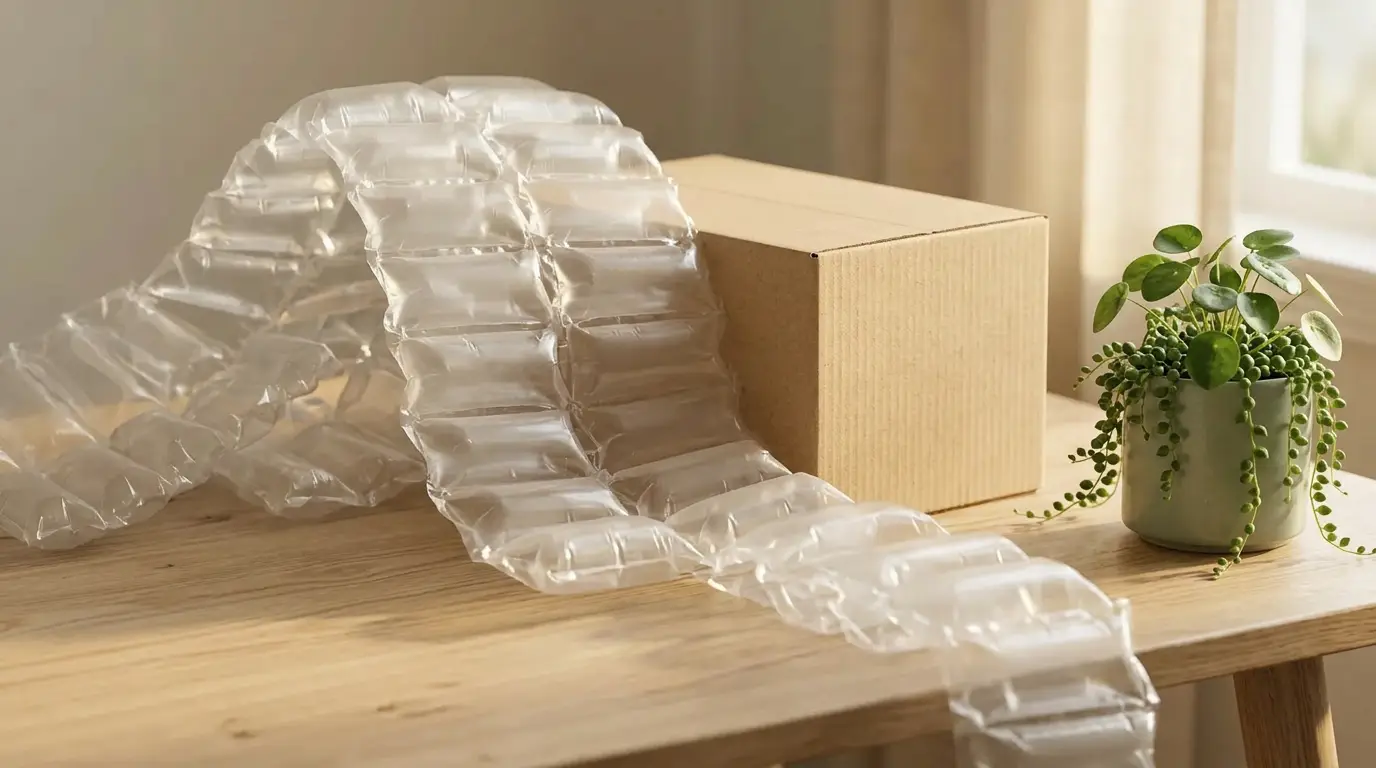
Bubble wrap, packing peanuts, and crumpled paper all share the same problem. They take up real volume to do their job. A package protected with two-inch-thick bubble wrap on every side is significantly larger, and therefore significantly more expensive to ship, than the same product protected with thin, conformable air pillows.
If your carrier invoices show DIM weight surcharges trending up quarter over quarter while your shipment count stays flat, your packaging is the variable. Switching to air-filled void fill alone can reduce DIM weight charges by 10 to 25 percent for typical e-commerce shipments because the packaging itself adds almost no volume.
This is one of the fastest forms of shipping cost savings available, and it requires no change to the products you sell, only to what you put around them.
Sign 3: You’re Treating Damage Claims as a Cost of Doing Business
Every operations team has a damage rate they’ve learned to live with. The problem is that “living with it” usually means absorbing three costs every time a package arrives broken:
-
The replacement product (COGS, plus pick and pack labor a second time)
-
The return shipping, if applicable
-
The customer relationship is measurable in churn, refunds, and negative reviews
When companies actually model this out, the all-in cost of a damage claim averages 3x to 5x the original shipping cost. A 2 percent damage rate isn’t a 2 percent problem. It’s closer to a 7-10% drag on margins for the affected products.
The fix is rarely “more packaging.” It’s usually better packaging: material that conforms to the product, immobilizes it inside the carton, and absorbs vibration during transit. Air pillow and air cushion systems are designed for exactly this. They fill irregular voids without crushing, and they don’t shift in transit the way loose fill does.
If your damage rate has been flat for years and nobody can explain why, that’s not stability. That’s a ceiling you’ve stopped trying to lower.
Sign 4: Your Packing Line Is Bottlenecked by Void Fill
Walk your fulfillment floor and time how long packers spend on void fill specifically. Measuring the box, cutting bubble wrap, scooping peanuts, crumpling paper, taping edges. For most operations, this is 30 to 60 seconds per package.
At 500 packages per day, a 45-second void-fill task adds up to 6.25 labor hours per day, roughly one full-time packer dedicated entirely to filling empty space.
On-demand air pillow systems compress this to 5-10 seconds per package. The machine inflates pillows on demand from a small film roll, the packer drops the right amount into the box, and the line moves on. Same protection, a fraction of the time.
If your packing line struggles to scale during peak season, void fill is almost always one of the bottlenecks. Removing it doesn’t require capital investment if you use a no-cost machine lease. It just requires changing the workflow.
Sign 5: You’re Paying to Store Packaging That Takes Up Warehouse Space
Bulk packing peanuts, pre-inflated bubble wrap rolls, and stacked foam inserts all share a problem. They take up enormous storage footprint relative to the protection they provide.
A pallet of packing peanuts protects roughly 200 to 400 packages and consumes 64 cubic feet of warehouse space. The same number of shipments protected by air pillows requires a single roll of unfilled film smaller than a microwave, because the air doesn’t exist until the packer needs it.
If your warehouse is paying $10 to $20 per square foot per year and a meaningful portion of that footprint is dedicated to packaging supplies, you’re renting expensive industrial real estate to store empty space. On-demand inflation eliminates that storage liability entirely.
How to Fix It: The On-Demand Air-Filled Solution
The pattern across all five signs is the same. Traditional packaging materials are pre-formed, voluminous, and labor-intensive. Each one creates a hidden cost somewhere else in the operation.
On-demand air pillow and air cushion systems address all five at once:
-
Material efficiency: packaging is created at the moment of use, not stored in bulk
-
DIM-friendly: air-filled materials add minimal volume to the package
-
Better protection: comfortable cushioning reduces damage rates significantly
-
Faster packing: 5 to 10 seconds versus 30 to 60 seconds per package
-
Smaller storage footprint: uninflated film rolls take up a fraction of the space
When you factor in all four hidden costs alongside material spend, on-demand air pillow systems typically reduce total packaging costs by 20 to 40 percent compared with traditional alternatives. The savings come from the entire stack, not any single line item, which is why companies that only benchmark material price often miss the opportunity entirely.
The other piece worth knowing: a no-cost machine lease program removes the usual barrier to switching. Most operations assume upgrading the packing line requires capital approval, an equipment purchase, and a multi-month rollout. A no-cost lease means the machine is provided alongside the supply contract, so the change is operational rather than financial.
Frequently Asked Questions
How much can a business realistically save by switching from traditional packaging to on-demand air pillows?
Most operations see a 20 to 40 percent reduction in total packaging cost when all five cost drivers are accounted for: material, labor, storage, DIM weight, and damage claims. The exact savings depend on shipping volume, current damage rates, and carrier contracts, but the largest single line item is usually labor time saved per package.
Does air pillow packaging protect as well as bubble wrap or foam?
For most product categories, yes, and often better. Air pillows conform to irregular shapes and immobilize products inside the carton, which is what actually prevents damage in transit. Foam and bubble wrap protect through thickness, which adds DIM weight without necessarily improving outcomes.
What’s the catch with a no-cost machine lease?
There isn’t one in the traditional sense. The machine is provided as part of the ongoing supply relationship. The business commits to purchasing the air pillow film through the provider, and the equipment is included. There is no upfront capital expense and no purchase price to amortize.
How long does it take to implement a new packaging system?
A typical changeover takes 1 to 2 weeks from contract to live operation, including machine delivery, packer training, and supply onboarding. The disruption to the existing packing line is minimal because the new system slots into the same workflow.
Is air pillow packaging recyclable?
Curbside-recyclable air pillow lines are available and meet most corporate ESG requirements. This is one area where it’s worth asking specifically. Not all air pillow film is curbside recyclable, so confirm the material specifications before assuming sustainability compliance.
The Bottom Line
If you’ve read this far, the question isn’t whether your business is overspending on packaging. It almost certainly is, somewhere in the cost stack. The question is whether the overspend is large enough to justify changing the system, and that answer depends on getting the full numbers in front of you.
The fastest way to find out is a packaging audit that maps your current material, labor, storage, DIM weight, and damage costs against an on-demand alternative. AIRFILL Technologies offers this analysis as part of the no-cost machine lease evaluation, with no purchase commitment.
Request a packaging cost analysis to see what your real number looks like.