Packaging decisions in the pharmaceutical and medical products sector carry more weight than in most industries. A damaged shipment is not just a financial problem. It can mean a product reaches a patient or healthcare provider in unusable condition, which creates risk across the supply chain that goes well beyond a simple return and reorder.
For procurement teams and operations managers at pharmaceutical distributors, contract manufacturers, and specialty pharma companies, the protective packaging question has to be answered at two levels: Does this material actually protect our products? And does it fit within the compliance and handling requirements our industry operates under?
This post covers both.
What Pharmaceutical Packaging Actually Needs to Do
There is a distinction worth making at the outset. Primary pharmaceutical packaging refers to the container that directly contacts the product, things like vials, blister packs, and sealed bottles. Secondary packaging refers to everything that protects and presents the product during distribution and transit.
This post is focused on secondary protective packaging: the cushioning, void fill, and blocking and bracing materials that keep pharmaceutical products physically safe during shipping. This is the layer where air pillow systems play a direct role.
Secondary pharma packaging needs to accomplish several things simultaneously. It needs to prevent product movement inside the shipping box. It needs to absorb impact from drops and compression during transit. It needs to be clean and free of particles, dust, or residue that could contaminate the outer packaging. And it needs to support the operational speed requirements of a pharma distribution environment without creating bottlenecks at the pack line.
Why Traditional Void Fill Falls Short in Pharmaceutical Distribution
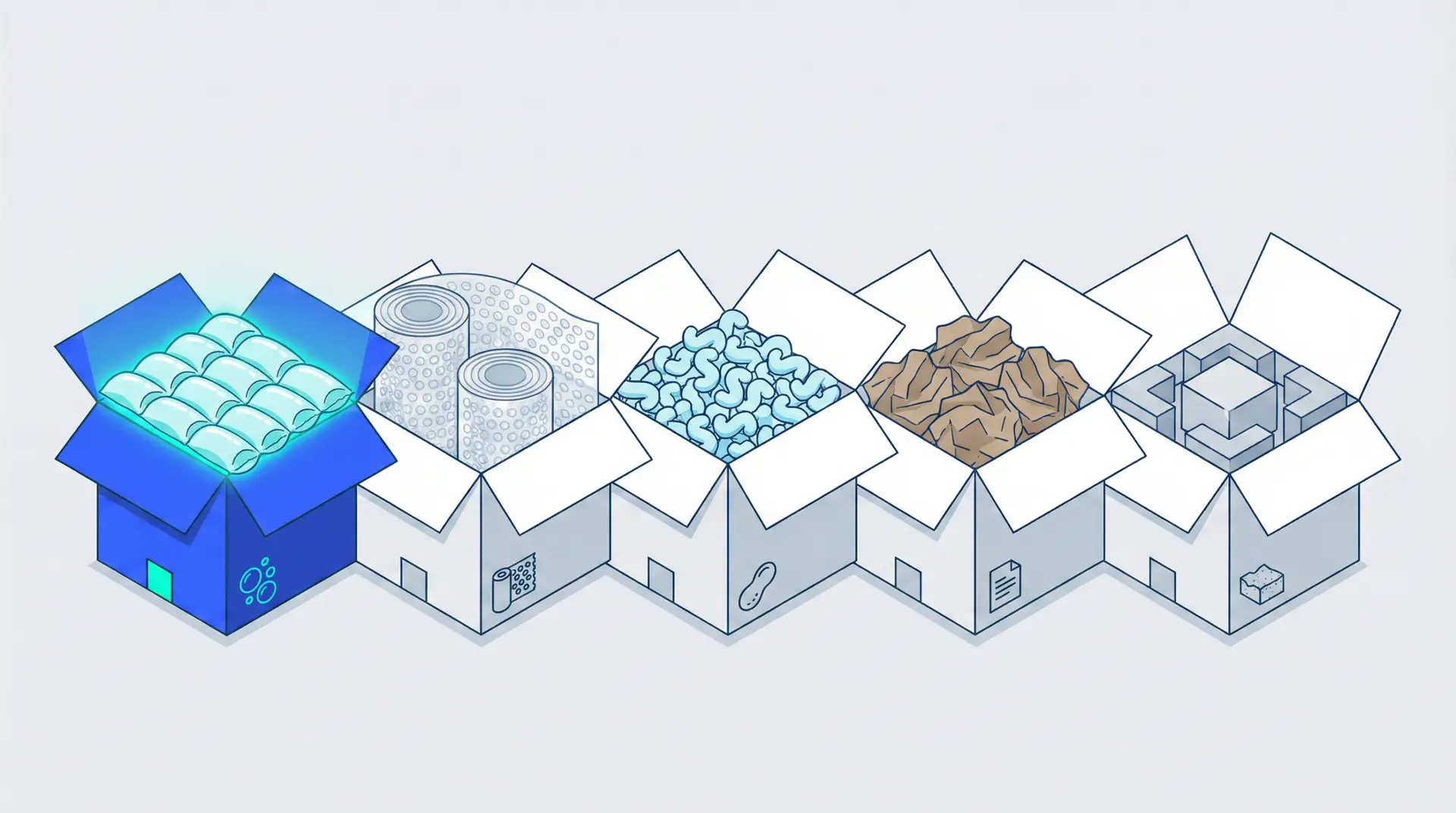
Loose fill materials like packing peanuts were once common across many industries, including pharma distribution. They create real problems in environments where cleanliness matters. They generate static. They migrate out of boxes. They leave residue. And they are slow to work with when pack speed is a priority.
Paper-based void fill is an improvement on cleanliness but introduces its own challenges. Paper dust and fiber particulates are a concern in environments with any level of controlled air requirements. Paper also requires more handling per shipment, which slows pack times and adds labor cost.
Air pillow systems solve both problems. The cushions are made from sealed plastic film. They produce no dust, no debris, and no particulate matter. They are placed cleanly and quickly at the pack station. And because they inflate on demand, the film arrives flat and clean without any contamination risk from storage exposure.
Air Pillow Packaging for Pharmaceutical and Medical Products
Air pillows function as void fill and cushioning for secondary pharmaceutical packaging by filling the empty space in a shipping box and preventing product movement during transit. When a pharmaceutical product shifts inside its outer box, it is exposed to repeated low-level impact against the box walls. Over a long transit, that adds up. Air pillows eliminate that movement by filling the void tightly and holding the product in place.
For fragile medical devices, glass vials, liquid formulations, and packaged kits, preventing movement is the single most important function a secondary protective packaging material can perform. Air pillows deliver it consistently and at speed.
AIRFILL’s air cushion systems are used by operations shipping across the pharmaceutical, biotech, and medical device categories. The systems are designed to run cleanly and efficiently in demanding distribution environments where pack line performance and product integrity are both non-negotiable.
Compliance Considerations for Pharma Shippers
Pharmaceutical distribution operates under regulatory requirements that vary by product category, channel, and geography. While secondary protective packaging materials like air pillows are not typically subject to the same direct regulatory scrutiny as primary containers, there are still compliance-relevant factors procurement teams should evaluate.
Material traceability matters. Being able to document what packaging materials were used for a given product lot is increasingly expected in pharmaceutical supply chains, particularly for serialized or track-and-trace managed products. Working with a supplier who can provide material documentation and lot traceability helps operations meet this expectation.
Material safety is another consideration. Film materials that contact or closely surround pharmaceutical outer packaging should be free of additives, inks, or treatments that could affect the packaging or product. Clean, food-grade film compositions are appropriate for most pharmaceutical secondary packaging applications.
Temperature sensitivity is relevant for a portion of pharmaceutical products. Cold chain packaging requirements are a separate and specialized topic, but it is worth noting that for ambient-temperature pharma shipments, air pillows provide reliable protection without introducing heat-generating materials into the box.
Operational Fit: Pharma Pack Lines and Air Pillow Systems
Pharmaceutical distribution environments often run high order volumes with strict accuracy and quality requirements at every step. Pack line efficiency is important, but it cannot come at the expense of quality control or consistency.
Air pillow systems fit well into this environment for several reasons. Machines are compact and integrate cleanly into existing pack station layouts. Film rolls are easy to load and change, which minimizes downtime. The inflation process is consistent, which means each cushion produced is the same size and has the same protective properties. There is no variability from one packer to the next the way there can be with hand-formed paper or manual wrapping materials.
For operations running multiple shifts or across multiple pack stations, that consistency is valuable. It means your packaging quality is not dependent on individual technique or judgment. Every box gets the same level of protection.
Scalability for Pharmaceutical Distribution Operations
Pharmaceutical distribution volumes can fluctuate significantly based on product launches, seasonal demand cycles, or contract wins. Packaging systems need to scale with the business without requiring major capital investment every time volume increases.
Air pillow systems scale efficiently. Additional machines can be added to pack stations as volume grows. Film roll consumption scales linearly with output. There is no large pre-purchase of pre-inflated materials required, which means your working capital is not tied up in stored packaging inventory beyond what you need for near-term production.
For procurement teams managing packaging spend across a pharmaceutical distribution operation, this combination of cost efficiency, scalability, and clean handling performance makes air pillow systems a strong choice.
Frequently Asked Questions
What packaging is used for pharmaceutical products?
Pharmaceutical products require secondary packaging that protects against physical damage during transit. Air pillow cushioning systems are widely used in pharmaceutical distribution for void fill, suspension, and blocking and bracing because they provide consistent protection without introducing contaminants or residue.
Do pharmaceutical shippers need special packaging materials?
Yes. Pharmaceutical and medical product shippers need packaging materials that are clean, residue-free, and capable of protecting products that may be sensitive to impact, compression, or excessive movement. Air pillow systems using food-grade or pharma-suitable film meet these requirements while delivering operational efficiency.
Can air pillows be used for medical packaging?
Yes. Air pillow systems are used across the medical and pharmaceutical distribution sector for secondary packaging and void fill. They protect products from physical damage during transit, produce no dust or debris, and can be deployed at high volume without slowing pack line operations.
Talk to AIRFILL About Your Pharmaceutical Packaging Needs
AIRFILL Technologies supplies air pillow packaging systems to pharmaceutical distributors, medical device companies, and biotech operations across the country. If you are evaluating your current secondary protective packaging and want to understand what an air pillow system would look like for your operation, we would be glad to walk you through it.
Call us at (844) 247-3455, email paul@airfilltechnologies.com, or reach out through our contact page and we will respond promptly.
Related Reading:
Air Pillow Packaging: The Ultimate Guide for Businesses
What Is Void Fill Packaging? Types, Benefits and Best Practices
How Air Cushion Machines Save Fulfillment Centers Thousands
5 Signs Your Business Is Overspending on Packaging