|
Key Takeaways ✓ Packaging costs extend far beyond the price of materials — they include storage, labor, shipping surcharges, damage losses, and customer churn. ✓ Oversized cartons, high damage rates, slow pack times, excessive storage use, and rising material spend are the five most common signs of a packaging problem. ✓ Most packaging inefficiencies compound over time and go unnoticed because they’re spread across multiple budget lines. ✓ On-demand air pillow systems address all five cost drivers simultaneously: lower material cost, smaller footprint, faster packing, less damage, and right-sized fill. ✓ A packaging audit focused on your top 20 SKUs by volume can reveal savings opportunities within the first week. |
Packaging is one of those operational costs that most businesses review once, set up, and then forget about. The materials get reordered on autopilot. The packing process stays the same because it’s “good enough.” Nobody looks at it again until something breaks — a spike in damage claims, a warehouse space crisis, or a CFO asking why fulfillment costs are climbing.
The problem is that packaging inefficiencies don’t announce themselves. They accumulate quietly across multiple line items: material spend, shipping surcharges, return processing, labor hours, and storage rent. By the time you notice, the total impact is significantly larger than any single line item suggests.
Here are the five clearest signals that your packaging is costing more than it should — and what to do about each one.
Sign 1: You’re Paying Dimensional Weight Surcharges on Most Shipments
The Problem
Carriers charge based on whichever is greater: actual weight or dimensional weight. Dimensional weight is calculated by multiplying the package’s length, width, and height, then dividing by a carrier-specific factor. If your cartons are larger than they need to be, you’re paying for empty air — literally.
This is the most common hidden packaging cost. A product that weighs 2 pounds but ships in a box sized for 8 pounds of DIM weight costs you the difference on every single shipment. At scale, that surcharge can exceed your actual material cost.
How to Spot It
• Pull your carrier invoices for the past 90 days and compare actual weight to billed weight on your top 20 SKUs.
• If more than 30% of your shipments are billed at DIM weight significantly above actual weight, your cartons are too large.
• Check whether you’re using one or two carton sizes for everything instead of matching carton size to product dimensions.
The Fix
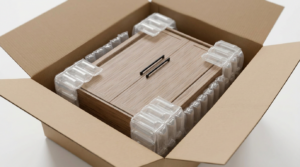
Right-size your carton inventory. Add 2–4 carton sizes to cover your product range with 1–2 inches of clearance per side. Then use on-demand air pillows to fill the remaining void precisely — no over-packing, no under-packing. Air pillows add negligible weight, keeping your actual and DIM weights aligned. For more on how void fill affects shipping economics, see our complete guide to air pillow packaging.
Sign 2: Your Damage Rate Is Above 2%
The Problem
A damage rate above 2% means your packaging isn’t doing its primary job: protecting the product through transit. Every damaged shipment triggers a cascade of costs — replacement product, reshipping, customer service time, return processing, and potential customer churn.
The math is straightforward. If you ship 5,000 packages per month at a 3% damage rate, that’s 150 damaged shipments. At an average all-in cost of $15–$25 per damaged order (product + shipping + labor), you’re spending $2,250–$3,750 per month on avoidable losses.
How to Spot It
• Track returns coded as “damaged in transit” separately from other return reasons.
• Include carrier damage claims in the count, even if you recover partial reimbursement.
• Monitor negative reviews that mention broken, crushed, or poorly packaged products — these represent damage incidents where the customer didn’t file a formal return.
The Fix
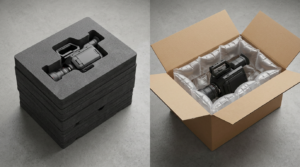
The root cause of most shipping damage is product movement inside the carton. Air cushion packaging eliminates that movement by filling void space with consistent, properly sized air pillows. Operations that switch from inadequate void fill to on-demand air cushions typically see damage rates drop by 40–70%. For a detailed breakdown, read our article on how air cushion packaging reduces shipping damage by up to 70%.
Sign 3: Your Pack Station Is a Bottleneck
The Problem
If your pack line can’t keep up with pick volume, the issue might not be staffing — it might be the packing process itself. Manual void fill methods like cutting bubble wrap, crumpling paper, or dispensing foam peanuts add 15–45 seconds per package depending on the material and carton size.
That doesn’t sound like much until you do the math. At 30 extra seconds per package across 1,000 daily shipments, you’re spending 8+ labor hours per day on void fill preparation alone. During peak season, that bottleneck forces overtime or temporary staffing that could be avoided.
How to Spot It
• Time the void fill step separately from the rest of the pack process for 20–30 packages.
• Watch for packers waiting on bubble wrap or paper to be cut, or spending time crumpling and shaping fill material.
• Compare your actual packs-per-hour rate against your theoretical rate based on pick speed.
The Fix
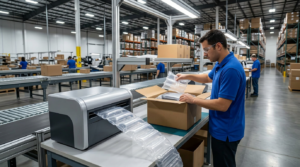
On-demand air pillow machines produce pillows continuously at the pack station. The packer grabs pillows as they’re produced and places them directly in the carton — no cutting, no crumpling, no measuring. Most operations see a 15–25% improvement in packs per hour after switching. AIRFILL’s auto inflation machines are designed for high-throughput environments and come with a no-cost lease program when you purchase film.
Sign 4: Packaging Materials Are Eating Your Warehouse Space
The Problem
Pre-made void fill is bulky by nature. Bubble wrap rolls, bags of foam peanuts, and bundles of kraft paper all arrive in their expanded state and need to be stored until use. In high-rent warehouse markets, every square foot dedicated to packaging materials is a square foot not holding sellable inventory.
This cost is easy to overlook because packaging storage is rarely tracked as a separate line item. It’s just part of “warehouse overhead.” But if you calculated the rent cost of the floor space your packaging occupies, the number would likely surprise you.
How to Spot It
• Walk the warehouse floor and measure the square footage dedicated to packaging material storage.
• Calculate the cost of that space based on your per-square-foot warehouse rate.
• Check how often you reorder packaging materials — frequent, large deliveries mean you’re cycling through significant storage volume.
The Fix
Air pillow film ships as compact, flat rolls. One pallet of AIRFILL film produces the equivalent of 10–15 pallets of inflated bubble wrap. That’s an 80%+ reduction in packaging storage footprint. The freed-up space can hold revenue-generating inventory or reduce your total warehouse square footage requirements.
Sign 5: Your Packaging Material Costs Keep Climbing
The Problem
If your per-package material cost has increased over the past 12–24 months without a deliberate change in packaging strategy, you’re experiencing material cost creep. This happens when buyers reorder the same materials at gradually increasing prices, when packers over-use materials without guidelines, or when product mix changes require more fill per carton than originally planned.
How to Spot It
• Compare your packaging material spend per package this quarter vs. the same quarter last year.
• Check whether your material suppliers have raised prices — and whether you’ve evaluated alternatives.
• Review packer behavior: Are some packers using significantly more material than others for the same SKU?
The Fix
Establish a per-package material cost target and measure against it monthly. Standardize packing guidelines with visual references for your top SKUs. And evaluate whether your current void fill material is still the most cost-effective option. Air pillow film at $0.03–$0.08 per package is consistently among the lowest-cost void fill options available, especially when you factor in the storage and labor savings. Browse film options and pricing in the AIRFILL catalog.
How to Run a Quick Packaging Audit
You don’t need a consultant to find packaging cost savings. A focused, internal audit on your top SKUs can surface the biggest opportunities in less than a week.
1. Pull your top 20 SKUs by shipment volume. These represent the majority of your packaging throughput and cost. Focus your audit here for maximum impact.
2. Calculate current cost per package. Include material cost, labor time (valued at loaded rate), any DIM weight surcharges above actual weight, and allocated storage cost for packaging materials.
3. Measure your damage rate by SKU. Some products are damaged more than others. Identify the worst performers and examine how they’re currently packed.
4. Time the pack process. Measure the void fill step specifically: how long does it take per package to prepare and place the fill material?
5. Calculate the storage footprint. Measure the floor space your current packaging materials occupy and multiply by your per-square-foot warehouse cost.
6. Model the alternative. Using the numbers above, calculate what your per-package cost would look like with air pillow film at $0.03–$0.08 per package, faster pack time, reduced DIM weight, lower damage rate, and 80% less storage space.
AIRFILL Technologies provides complimentary packaging assessments for operations shipping 100+ packages per day. If you want help running the numbers, reach out to the team directly.
Frequently Asked Questions
How do I know if my damage rate is too high?
Industry benchmarks vary, but most well-managed e-commerce operations target a damage rate below 1–2%. If you’re above 2%, there’s likely a packaging improvement opportunity. If you’re above 5%, packaging should be an immediate priority.
Can I reduce costs without changing my current carton sizes?
Sometimes — switching to a lower-cost void fill material can help even with existing cartons. But the biggest savings come from right-sizing cartons AND optimizing void fill together. The carton is the biggest driver of DIM weight, and void fill effectiveness depends on having the right amount of space to fill.
What if my products are all different sizes?
That’s exactly where on-demand air pillows excel. Because you produce the fill at the pack station, you can match the exact amount to each carton without pre-cutting or pre-sizing. Two or three film types cover most product ranges.
How quickly can I see cost savings after making changes?
Material cost savings are immediate — you’ll see the difference on your first film order compared to your current void fill spend. Damage reduction takes 30–60 days to measure statistically. Storage savings materialize as you draw down existing packaging inventory and don’t replace it.
Is it worth switching if I only ship 100–200 packages per day?
Yes. The per-package material savings apply at any volume. The workflow and storage benefits become more pronounced as volume grows, but even at 100 packages per day, the math typically favors air pillows over bubble wrap or paper void fill. AIRFILL’s no-cost machine lease program means there’s no equipment investment to amortize.
|
Think your packaging might be costing more than it should? Request a complimentary packaging cost analysis from AIRFILL Technologies. Call (844) 247-3455 | Visit airfilltechnologies.com |